Menu
How Concrete Foundation Repair Works in South Jordan
Concrete Foundation Repair South Jordan
Concrete foundation repair methods provide homeowners in South Jordan with an opportunity to develop a plan of action to address structural issues while still preventing them from creating safety concerns for their home and decreasing its market value. Through the combination of professional foundation repair and innovative technologies that are based on Utah’s geographical and climatic conditions, professional foundation repair can be tailored to meet the needs of the state’s clay soils and freeze-thaw cycle environment. Homeowners who seek early evaluation and targeted repairs will avoid the possibility of the small problems becoming major structural problems. Additionally, because South Jordan is located in a region that experiences clay soils and freeze-thaw cycles, it creates a unique set of foundation stresses that require a repair strategy that has been specifically developed to address those types of stresses. With this information, homeowners will have the ability to identify early warning signs of potential issues and select the best repair options available to resolve the issues at hand.
Typical Foundation Issues in South Jordan
The expansive nature of clay soils in South Jordan presents specific foundation concerns in that clay soils expand in the wet months, then shrink in the dry months. The constant expansion and contraction create an ongoing cycle of stress that ultimately causes cracks in the foundation walls, and the foundation floor will also settle unevenly, creating structural displacement over time. Additionally, Utah’s freeze-thaw cycle can lead to deterioration of concrete in areas of the home that are most susceptible, such as basement walls and at the perimeter of the foundation. All homes in the South Jordan area, whether it is a new development or an older neighborhood, are exposed to the same types of soil-related foundation problems that need professional repair.
Identifying When Professional Help is Needed
Homeowners need to be aware of the signs of foundation problems. Some of these signs include cracks in the walls and/or floors larger than 1/4 of an inch, horizontal cracks in the basement walls, doors and windows that do not open and close normally because of seasonal settlement, and any gap between the top of the foundation and the ground. Anytime you notice water coming into your basement after heavy rain, a musty odor in your basement, or if you notice that your floors are sloped, you likely have foundation problems that need to be addressed. It is generally easier and less expensive to fix foundation problems early (repair costs $2,000 to $5,000), versus waiting until later (repair costs up to $20,000 or more).
Low-pressure Crack Injection Repair Techniques
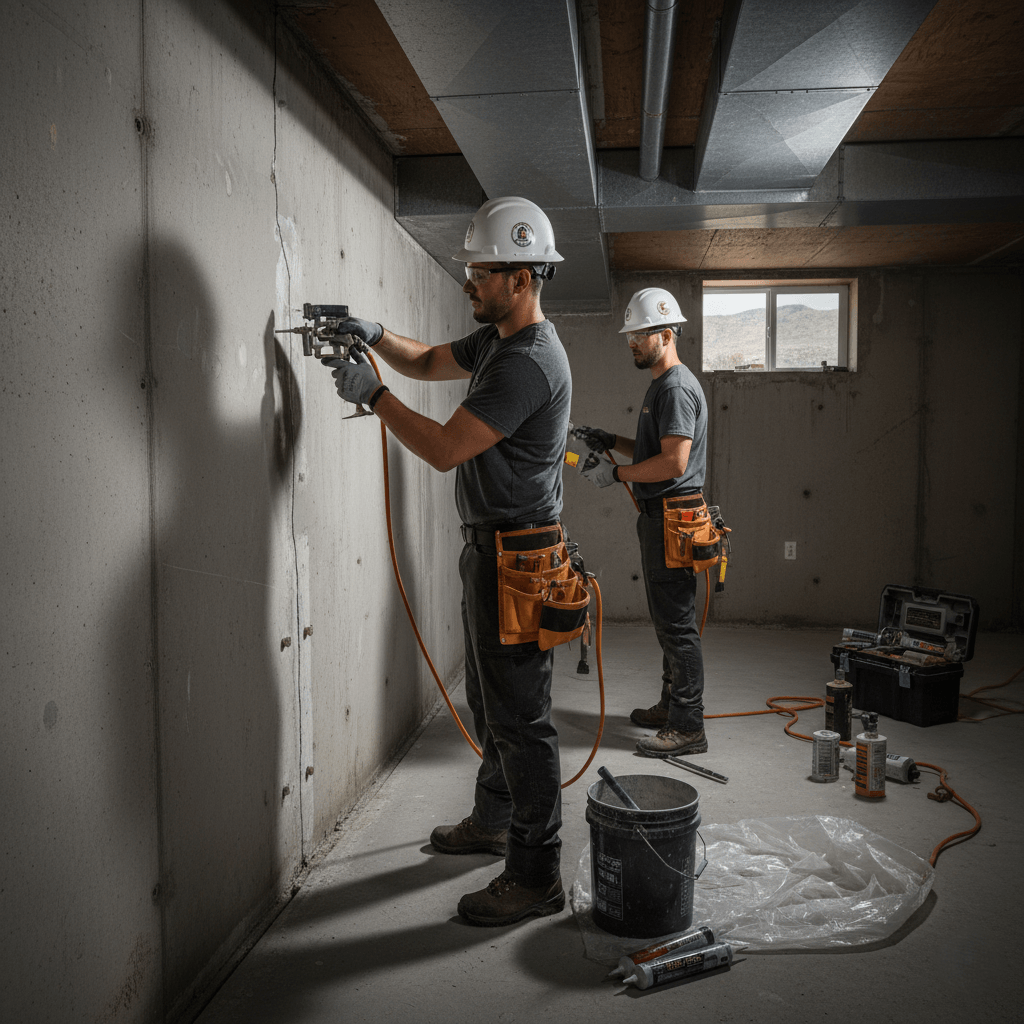
Concrete foundation repair using low-pressure crack injection systems is a very popular way to repair cracked foundations without excavating, and therefore saving homeowners money. This crack repair method consists of two main steps: first, install an injection port along the entire length of the crack(s), and second, apply either epoxy resin or polyurethane resin to fill and seal the damaged areas. Epoxy resin is used to restore structural integrity to non-moving cracks (cracks resulting from initial settling or construction stress), whereas polyurethane foam is more effective at repairing cracks that result from the seasonal movement of the soils in South Jordan.
Selecting Between Epoxy and Polyurethane Resin
Epoxy resin creates a rigid bond between the crack surfaces, which is beneficial for restoring the structural integrity of the foundation where there were no additional stresses beyond initial settling or construction, and therefore creates a stronger bond than polyurethane. On the other hand, polyurethane foam is more flexible and therefore can continue to allow for some movement of the foundation due to seasonal changes in the soil in South Jordan. Therefore, professional contractors use a combination of assessments (assessments of the crack pattern, soil conditions, and seasonal movement) to determine the correct type of resin to use to ensure a successful and long-lasting repair.
Steel Pier Installation
In cases of severe foundation settlement requiring a more substantial repair solution than crack injection alone, steel piers are used to permanently support the foundation by transferring the load-bearing weight from the unstable surface layer down to the solid bedrock below. The depth of the piers varies from 20 to 70 feet, depending upon the depth of the bedrock.
Concrete Pier Installations
For moderate settlement problems, a concrete pier system can be installed, which extends approximately 10 to 12 feet below grade and is rated with a minimum 7,000 psi compressive strength rating. A typical concrete pier installation is designed to provide a reliable repair solution for many foundation settlement problems found in South Jordan’s neighborhoods.
Structural Evaluation Process
A comprehensive structural evaluation of the foundation is performed by a licensed contractor to assess and diagnose foundation damage. The evaluation includes inspecting the foundation for cracks and defects, evaluating the soil conditions surrounding the foundation, assessing the amount of settlement of the foundation, and determining the overall condition of the structure. The costs associated with a structural evaluation vary and can range from $400 to $750; however, the benefits of having a properly diagnosed problem far outweigh the costs, and ensure that the repair solutions selected will address the actual cause of the problem and not just the symptoms.
Design Requirements for Structural Repairs
When complex structural foundation problems are identified, a structural engineer may need to consult on the repair design to ensure that all of the required repairs meet local building codes and specifications. The costs associated with hiring a structural engineer can range from $500 to $3,000 and are necessary to provide a detailed specification of the required repairs, including the number and spacing of piers, the required reinforcement details, and the sequence of repairs. The structural engineer will also verify that the proposed repairs are sufficient to stabilize the foundation and provide adequate support for the structure.
Factors Influencing Repair Cost
Repair costs for concrete foundation problems in South Jordan can vary widely based on the extent of the repair needed, the repair method chosen, and the ease of access to the repair location. For example, minor crack injection repairs may cost anywhere from $250 to $800 per crack, while large-scale underpinning projects may cost anywhere from $4,500 to $20,000 or more, depending on the number of piers required and the complexity of the repairs. Both the size of the foundation and the soil conditions can impact the final repair costs.
Advancements in Polyurethane Foam Lift and Void Filling
An innovative advancement in concrete repair techniques is polyurethane foam lift and void filling. Polyurethane foam lift is a method of raising sunken concrete slabs using polyurethane foam. The foam is injected into the space between the sunken slab and the surrounding soil. As the foam expands, it raises the slab back to its original position. This process is commonly used for sidewalks, garage slabs, and basement floors that have settled due to soil erosion or compaction. The cost for this service can vary depending on the size of the affected area and the amount of foam needed. Generally speaking, the cost can range from $300 to $1,500.
Limitations of Polyurethane Foam Lift
While polyurethane foam lift and void filling is an excellent solution for many applications, it does have its limitations. It is most suitable for areas that have experienced slight to moderate settlement. If a foundation has undergone extreme settlement, this method is usually not practical. Furthermore, this application works best in conjunction with other services, such as drainage improvement, in order to eliminate moisture issues that could lead to further damage.
Combining Waterproofing Services
While waterproofing is not always included in a standard foundation repair job, it is often recommended to include waterproofing components in order to provide protection against future water damage and foundation deterioration. In addition to waterproofing coatings applied to the exterior of the foundation walls and floor, interior drainage systems and vapor barriers can be incorporated into a comprehensive foundation repair job to control the entry of moisture that could compromise the integrity of the foundation.
Time Frame and Project Scheduling
Typically, concrete foundation repair jobs take anywhere from one to five days to complete. Small jobs involving simple crack injection repairs can be completed in a single day, while more extensive jobs that involve pier installation and underpinning may require several days, including the time required for excavation and curing of the concrete. Weather conditions can affect the timing and scheduling of foundation repair jobs, especially those jobs that require work outside of the house and the curing of concrete in outdoor environments.
Understanding Local Soil Conditions
South Jordan is located in an area where the soil conditions are dominated by expansive bentonite clays. Because of their high expansion potential and moisture sensitivity, these soils present unique challenges for foundation repair. Contractors who specialize in foundation repair in the South Jordan area are familiar with the local soil conditions and develop repair methods that take into account the seasonal movement of the ground.
Warranty and Quality Control
Reputable contractors offering concrete foundation repair services will offer a warranty on their work. The length of the warranty varies, but it can last anywhere from one to ten years, depending on the type of repair performed, the materials used, and the contractor. The purpose of a warranty is to provide assurance to homeowners that the repair work was done correctly and to protect the homeowner if the repairs fail prematurely.
Maintenance and Preventative Measures
After completing a foundation repair job, the homeowner must perform regular maintenance on the repaired foundation in order to avoid future problems. Some of the ways to perform maintenance include maintaining consistent soil moisture levels through good landscaping and irrigation practices, and performing annual foundation inspections to detect any problems that may be developing. By taking proactive steps to monitor and maintain the health of the foundation, homeowners can minimize the likelihood of future repair needs and protect the structural integrity of their home.
Coordinating with Other Home Systems
During a foundation repair job, it is not uncommon for the homeowner to have to deal with modifications to other home systems, including plumbing, electrical, and HVAC. Professional contractors specializing in foundation repair will take the necessary precautions to protect these systems and restore them to working order once the repairs have been completed. This will minimize the risk of damaging other home systems and ensure that all systems operate properly once the foundation has been restored.
South Jordan Concrete Pros has extensive experience in concrete foundation repair in the South Jordan area. We utilize the latest technology and techniques, combined with our knowledge of local soil conditions and structural requirements, to provide comprehensive repairs that will solve the homeowner’s immediate repair needs while protecting the foundation for years to come.
LATEST POSTS